
Research and expat life: a positive association? – summer edition
Summer is at the doorstep, and for many Swedes this means, leaving the cities and moving to the countryside into their summer houses, for several weeks (4-6) of absolute bliss, rest and rehabilitation, in the Swedish wilderness. For expats, summer can mean quite the opposite – stress. This is due to a number of factors. Expats get trapped in the decision wheel of whether they want to a) stay in Sweden, or Scandinavia for that matter, to explore the beautiful nature and country around them OR b) go to visit their home countries and families OR c) go on vacation abroad to see something new.
For many, going back to their families in summer is a nice option, to spend some more prolonged quality time with loved ones, who you may or may not see more than a couple times a year. To catch up on life events that one has missed, witness how (grand)parents have aged or realise how nieces and nephews may have grown into actual people. These visits are usually bittersweet, and can be stressful in themselves as well, as often those trips (depending of course on duration) are packed with seeing and meeting as many people as possible. If you are lucky enough to have a still a big family or several intact childhood friendships.
Then there is the dilemma that summer is considered for many as the best season in Sweden. Lush meadows, temperate climate, glittering water surfaces, deep forests, quaint villages and archipelago charm. Hiking, cold-water swimming, sailing, sauna-ing or just prevailing in gardens full of wildflowers, are only some of the stereotypical, yet wonderful activities you can do in Scandinavia in summer. Then, there is the issue that Sweden is a huge country, so if you would like to see another region than the one you live in, e.g., for many Stockholmians this is the Swedish West Coast or the South, one would need at least a couple of weeks off to explore. Not even to mention how far away the beautiful North is from most populated places in the country…. Weekend trips are nice, but will not get you very far.
At the same time, the weather in Sweden is no guarantee, even in summer, so if you are looking for a sun-soaked beach holiday, a trip to Southern Europe may be a better choice. If you are looking for an exotic adventure, long-distance destinations may be an option. Many may also feel like they would just like to see something else, discover something new, and not ‘just’ return to their familiar hometowns and/or the place that they already spent most of their year and everyday in.
The thing is, to come back to the actual point of this blog post, that there seems to be a rather strong association between being a researcher and an expat. Academia for a big part expects you to be adaptable and flexible, in many aspects. The most common starting point of expat life is the move to study abroad. There you have it. Expat life has started. And this is fairly common. Coming from Luxembourg, it is commonplace that people move abroad for their studies (we only have 1 university). Many do return after their studies, but there is a significant amount of people that gets ‘stuck’ in the expat life. Either because they like the place and life they built in the city where they studied, or they keep moving. If you stay in academia, there is a strong likelihood that you may do your PhD elsewhere than your undergraduate and graduate studies. And after the PhD, you are even generally expected to change research group, and that often entails moving elsewhere, again. Then, throw in this pot also the issue of those short-term employment contracts, that will naturally, maybe involuntarily, keep you moving… Eventually, this lifestyle creates some kind of patchwork network of family and friends spread across the globe. Each and single one of them expecting you to visit them, and obviously this is what you want too, but it would require 3 versions of yourself, and many, many more days of annual leave, to make everyone happy, including you.
Obviously, expat life has many benefits. You get to see many new interesting places, meet international friends and life may just feel like a constant adventure. However, several may also feel homesick, like they never really fit in or have issues in finding good friends or a social support network. And then there is the guilt. The all-too-familiar guilt that is always there at the back of your mind, hindering you from fully enjoying yourself in your newly selected home or celebrating your prolonged employment contract. Guilt of leaving the family behind or mainly just the choice, your choice to live so far away from family and friends that may make them feel like you do not love them enough. Transfer this then to the summer, where you feel trapped in the decision of how you want to spend your summer months and may not be able to choose what you want to do – but rather, what you feel you should do. Add an international partner or children to the mix, and you become quickly overwhelmed by your and others’ expectations of where and how you are supposed to spend your free time. And there comes Christmas, so the whole decision-wheel starts spinning again.
Also, if you identify as climate-conscious, have a fear of flying or are simply a dog owner (raised hand), and you may have a habit of traveling by train – the trip alone from Sweden to elsewhere quickly turns into a small ‘Tour de L’Europe’, that requires in itself already several days of leave to both travel, and recover from it.
Being able to work remotely helps a lot, so one does not always have to take annual leave to ‘just’ visit family and friends – but still, of course, it is not the same. Also, the fact that you are legally entitled in Sweden to have 4 continuous weeks off during the period of June-August is an immense privilege. Yet there are no easy solutions. Annual leave is limited. Life is hard. Expat life and/or life as a researcher, which has more similarities to nomad-life than many would like, is even harder. It is complex, and there are no easy choices nor solutions that will make everyone, always happy. Now I am also speaking from the perspective, and privilege, of a Western European. As some expats, in- or outside of academia, may have had to involuntarily leave their home country to find peace.
If you are looking for an easy, stress-free and uncomplicated life, I would probably not recommend a career in academia, nor to get started with expat life. Yet still, I want to have it for myself, for now.
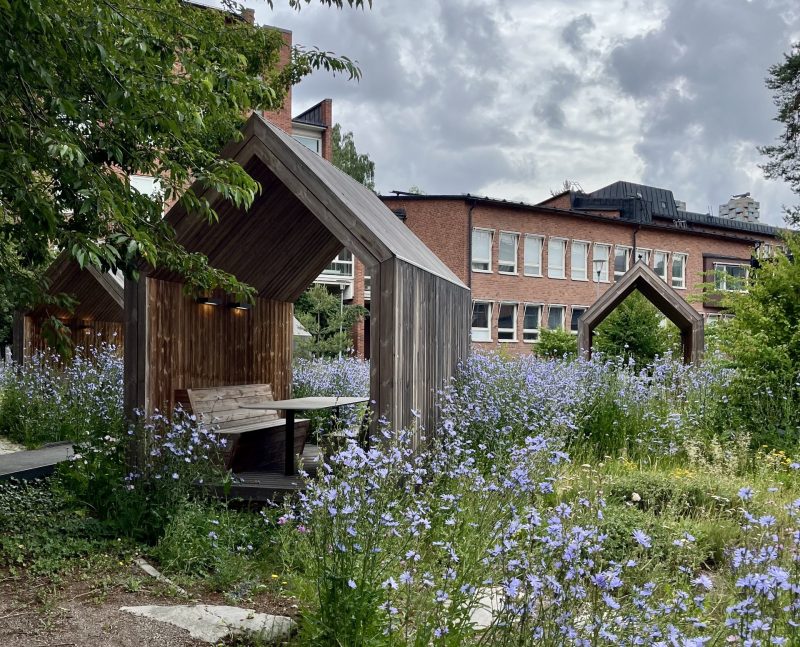
P.S. Pictured on the cover image is the beautifully wild and biodiverse garden at the Institute of Environmental Medicine on the KI Campus in Solna.

0 comments