
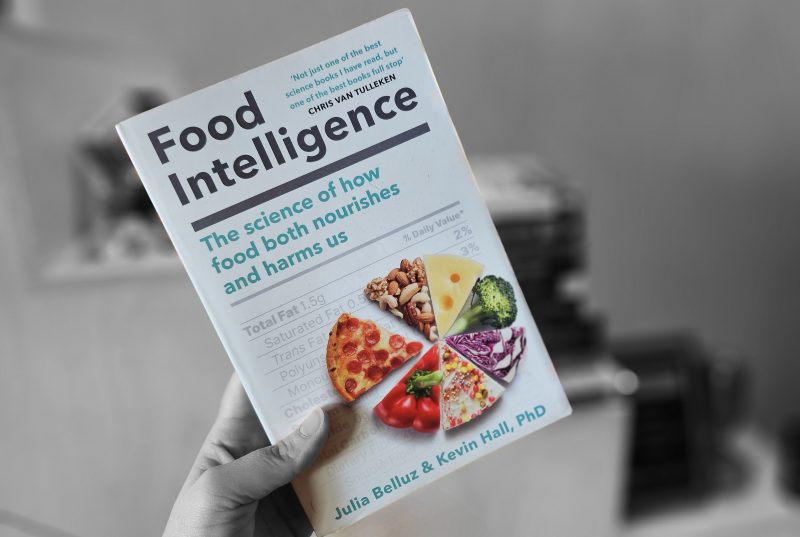
Food Intelligence: the book that reignited my love for science
Ok, so I got on the waitlist to order the book Food Intelligence right after I listened to a Dr. Mike podcast interviewing one of the authors, nutrition scientist Kevin Hall. I’m not even sure why I was so eager to get it at the time. I must confess I am usually too tired from reading the whole day that I rarely do so in my free time. But looking back at it now, I think it was about how raw, honest, and truthful he was about science. And it reached a part of me I thought I had lost. It spoke to the kid in me who loved science for what it is (or should be).
Disclaimer: this post is highly personal, almost a therapy session for scientists (like me) losing sight of their purpose. This is not a book review per se; if you’d like that, here is a great one. Here I am sharing how the book healed me a little, while hopefully, I will be spreading a bit more love and understanding for science.
I knew I wanted to work with science very early on. I’ve changed the area I wanted along the way, but there has never been another option. A journal entry from when I was 11 read “today I decided I want to be a biologist!” One bachelor’s in biology and a PhD in biochemistry later, things are not as clear anymore. I was so certain. I see young researchers around. And I envy how sure they are. How they are pursuing what they love. Am I not, though? Oh, wait, I am. That’s the realisation I had from how Kevin talked about science.
My idea of what happens to us… We simply get lost. We get lost in the low pay, long working hours, in the competition! For what? I ask. I see senior researchers, and how I myself am becoming just like them, obsessed with CV, the next big publication, the teaching hours, and the grant application. We stop asking questions because they are fun or important. We ask the ones we can get funding for. We stop supervising or teaching because it brings us joy; we do it as an obligation. Just another stepping stone (never mind we might be stepping on the future of science).
Now the easy way out is to blame it on the system. Don’t get me wrong, the system has its fair share of guilt. But this is not unique to science. It is a high-performance issue. We researchers are high performers. No one gets far in science if they are not. Oh, the competition. Like athletes, artists, and anyone at the forefront of a field they love. We put all our bets on that field, that career. Love becomes our work, work becomes our life, life becomes… Boring? Unidimensional? Dangerously miserable. We lack “lagom”. We lose perspective. Everything is the same, nothing brings joy.
Back to the book and the authors, Julia Belluz and Kevin Hall. A brilliant journalist who has struggled with weight loss and a physicist turned nutritional scientist paired up to provide the most truthful and transparent account of the food industry and food science. They don’t promise you any formula for weight loss, they don’t villainise sugar, or meat, or fat, or protein, or ultra-processed foods (maybe a little, but UPFs don’t help themselves). The point is, they are not selling answers or giving free advice. They have been just as confused as we are. About what and how to eat, how to separate good from bad evidence, and how to navigate science. And truth be told, there is no better description of science. We are at the frontier of knowledge. The whole point is that “We do NOT know.” Otherwise, we would be out of a job. But medicine wants us to provide solutions, the public wants us to be sure and never change our minds, the funding agencies (with some exceptions) want us to be certain of our success, and most journals want us to produce only positive or exciting findings. Good Darwin, that is the opposite of what science is! So, when realising they have been struggling with not knowing, but still they approached the issue with curiosity, it warmed my scientist’s heart. It was a reminder of what kind of scientist I want to strive to be. The one that asks questions, or even “questions” herself and others. The most obvious and accepted things in health science are not that obvious and are actually quite tricky. What is the significance threshold? What about sample size calculation?
There is no right way sometimes. We need to normalise conflict to an extent, and we need questioning. It is not an affront to people’s egos. We are here to work together, not against each other. Why do we have such competition in the first place? I want to support science! And if someone else discovers something amazing, I want to cheer with them. If something is questionable, I want to ask the right questions. If I am teaching, I want to contribute but also learn with them. And I want the space and support to be utterly wrong. There is no true discovery otherwise, if we do not push the boundaries of knowledge. It is uncharted territory, and that is the beauty of it. That is my purpose: “To boldly ask the questions no one asked before.” Live long and prosper, everyone.
Until we meet again,
Alana

0 comments