
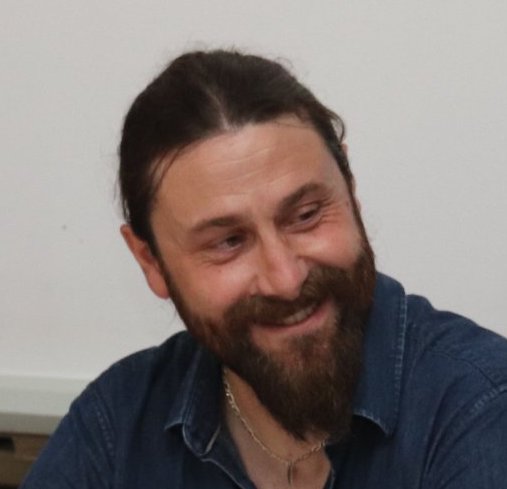
Building Science, Community, and Creativity: The Journey of Xesús M. Abalo
For many researchers, scientific careers are often imagined as linear paths: a PhD, postdoctoral researcher, an academic position, and eventually leading an independent research group. However, for Xesús M. Abalo, the journey through academia has been far more dynamic, shaped by adaptation, curiosity, creativity, and a willingness to reinvent himself when circumstances changed.
Currently Xesús is a Project Coordinator at the National Genomics Infrastructure (NGI) Stockholm, SciLifeLab and KTH. Previously he has worked as a Principal Investigator in neuroscience research before transitioning into scientific infrastructure and genomics support. Alongside his scientific career, he also serves as President of the Association of Spanish Scientists in Sweden and is a published novelist.
What emerged from our conversation was not only a story about science, but also one about resilience, identity, creativity, and redefining what success means over time.
From Galicia to Sweden
Xesús’ scientific journey began in Galicia, Spain, where he started his PhD in neuroscience at the University of Santiago de Compostela in the early 2000s.
His interest in biology began even earlier. As a child, he initially dreamed of becoming a veterinarian, but later shifted direction, eventually, he found himself choosing between philosophy and biology before deciding to pursue biological sciences.
After completing his PhD, he moved to Sweden in 2006 for a postdoctoral position at Karolinska Institutet. The move represented both a scientific and personal transition, a new country, a new culture, and a new academic environment.
Reflecting on that period, he also highlights a challenge many international researchers encounter: the insecurity associated with stipend-based positions.
“I realized afterwards that I wasn’t paying taxes during my postdoc stipend. ”
“That’s something I would advise students to think about. Nobody working should do it without being paid properly.”
Following his first postdoc at KI, Xesús moved to Uppsala University for another postdoctoral position focused on visual systems and phototransduction in fish models such as zebrafish and lampreys. His research explored the proteins involved in vision, including opsins and G proteins, and how visual systems have evolved and adapted across different fish species. There, he eventually secured funding, supervised students, and established his own research group.
“It was a fantastic period,” he recalls. “I got funding, I started my own group, and I had students.”
Reinventing a career beyond the PI track
Like many academic careers, however, the trajectory was not without instability. Funding became uncertain, departmental restructuring occurred, and eventually he faced the difficult reality that continuing as a PI was no longer feasible.
Rather than framing the transition as failure, Xesús describes it as a process of reinvention, “I had to reinvent myself,”. He later joined the group of Joachim Lundeberg at SciLife Lab, working with spatial transcriptomics, a field that would eventually lead him into his current role at the National Genomic Infrastructure.
Today, he works as a Project Coordinator handling a wide range of genomics and spatial transcriptomics projects from researchers across Sweden and internationally.
The role combines scientific guidance, project management, communication, and operational coordination.
“I talk a lot,” he says jokingly. “Meetings with users are one of the things I do most, and actually it’s one of the nicest parts of the job.”
His work involves helping researchers choose appropriate methodologies, discussing experimental design, coordinating workflows, and ensuring projects follow highly standardized quality procedures within a large scientific infrastructure.
The transition from PI work to facility-based science also changed the scale and nature of his interactions with research.
“As a PI, you work deeply with a smaller group of people and projects … Here, it’s more like high through, many projects, many users, many research questions.”
Scientific culture and life in Sweden
Having experienced academic systems in both Spain and Sweden, Xesús reflects thoughtfully on the differences between the two research cultures.
When he started his PhD in Spain, he recalls how financial insecure the process initially was. For the first two years, he worked without salary until eventually receiving government funding.
“This has changed now, fortunately,” …. “But Sweden was very different from the beginning. Here, PhD students are employees, they have salaries, stability, and security.”
Beyond funding structures, he also describes a broader societal appreciation for research in Sweden.
“When I was doing my PhD in Galicia, I explained my work to a friend, and he asked me: ‘Okay, but when are you going to start working? In Sweden, it’s the opposite. You can talk to almost anyone about science, and people understand that research matters.”
For him, this respect for research and development is one of Sweden’s greatest strengths.
Persistence, uncertainty, and academic reality
Throughout the interview, Xesús repeatedly returned to the emotional realities of academic life: uncertainty, persistence, and adaptation.
His advice to prospective PhD students was notably honest.
“If you want to do a PhD, don’t do it 99% …. You need to want it 150%.”
He describes academia as a path filled with ups and downs, where hard work does not always guarantee fairness or immediate reward.
“Sometimes you feel things are unfair,” he explains. “You work a lot, and maybe someone else progresses faster. But if you really want it, you persist.”
At the same time, he emphasizes that the skills developed during a PhD extend far beyond technical expertise.
For him, one of the most valuable transferable skills is perspective itself.
“We are just one more species among thousands,” he reflects. “Human beings think we are special because of our consciousness, but other animals have abilities we don’t have. This broader perspective changes how you see life.”
Building scientific communities
Outside his scientific role, Xesús also dedicates significant time to scientific community building as President of the Association of Spanish Scientists in Sweden.
The organization was founded in 2014 to help Spanish researchers and professionals connect, network, and maintain scientific and cultural ties while living abroad.
Although he initially joined simply as a participant, he later became Vice President and eventually President.
What motivates him to continue despite the role being entirely voluntary?
“My daughter asks me all the time: ‘Do you get paid for this?’” he says, smiling. “And I say no. The reward is seeing that something you spent months organizing became meaningful for people.”
Under the association, he and his colleagues organize events combining science with music, astronomy, sports, and outreach activities. One particularly memorable event involved hosting a Spanish astronaut at the Spanish Embassy in Stockholm. For him, scientific leadership is ultimately about helping people connect.
Writing fiction between Stockholm and Uppsala
Perhaps one of the most unique aspects of Xesús’ journey is his parallel life as a writer.
During the years he spent commuting daily between Stockholm and Uppsala, he filled the long train rides with reading and writing.
“I was reading a lot …. And then one day I just decided to write a small story.”
Over time, those stories accumulated. During a period of unemployment between positions, he revisited them, edited them, and decided to pursue publication seriously.
He submitted the manuscript to multiple publishers. Three expressed interest.
Eventually, his collection of 21 interconnected stories became a published novel. The process revealed a creative freedom very different from scientific writing.
“In science writing, there should not be room for interpretation …. But in novels, I can do whatever I want.”
He especially enjoyed seeing readers interpret his stories in ways he himself had never intended.
“That was very rewarding.”
Even now, he continues writing and hopes to finish another novel soon.
Rethinking success
Toward the end of the conversation, I ask about his definition of career success
His answer is unexpectedly simple
“My daughter once described herself using only one word – happy.”
For him, that gradually became the most meaningful definition of success as well.
“If it’s Sunday evening and you are not suffering because Monday is coming, then that’s a good sign.”
“We are not here for so long. Try to enjoy.”
It was perhaps the most memorable line of the entire interview, a reflection not only on science careers, but on life itself. And maybe that perspective, balancing science, adaptation, creativity, and happiness, is exactly what makes journeys like his so valuable for early-career researchers to hear.

0 comments