

Stepping stones to expertise: The European Competence Framework
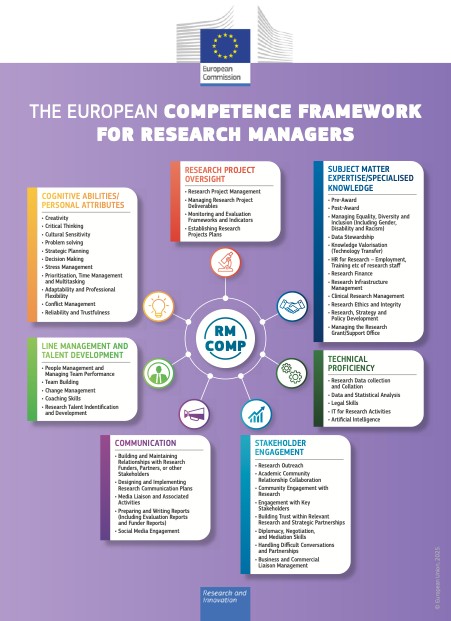
Sooner or later, every researcher probably comes across the ERA (European Research Area) Talent Platform, whether as a budding scientist or a seasoned veteran. I was recently reminded of the interesting resources the platform provides, such as a variety of EU competence frameworks. These frameworks were developed by the European Commision as a tool to assess and develop one’s transferrable skills to help build inter-sectoral careers. Needless to say that, with eager curiosity, I delved into “The European Competence Framework for Research Managers (RM Comp)” to discover how the skills required for my tasks as a laboratory manager overlap with those listed in the framework and to see which nuggets of wisdom I might find to share with you.
Before we proceed with said nuggets, let me give you a small glimpse into some of what I do. If you have ever worked in a lab, you are probably familiar with issues such as “How does this work?”, “Where can I find X?”, “Someone finished Y!”, “I would like to get help with Z.”, or “This instrument has stopped working.”. Let’s be honest, this might even be true in everyday life. However, in the lab, I am there to solve these issues or to try and prevent these types of questions from becoming emergencies. More importantly, I am here to make sure that all work is done safely and according to regulations. Now, with this in mind and without further ado, I hereby present:
Nugget number 1: “What’s in a name?”
It did not take long for me to be reminded of one of Shakespeare’s famous lines referring to the arbitrary nature of names. I soon discovered that the research manager’s role in this framework does not quite relate to that of a laboratory manager, even if in a research lab. So, what’s in a name? At first glance, the title “research manager”, also called “research & development manager”, appears to differ from that of a “laboratory manager” in that the level of responsibility regarding certain tasks differs between both roles whereas other tasks differ entirely.
Nugget number 2: Transferrable skills are… well, transferrable.
Despite the differences in these perspective roles, there is a large overlap in the competencies I rely on for my tasks and those listed in the RM Comp. Note that this is also true for many of the skills listed in “The European Competence Framework for Researchers (Research Comp)” which seem to be aimed more towards the early-career scientist. So, even though I did not pursue a PhD, which is often considered required for more senior scientist roles, I found it very interesting to discern how I have had a chance to develop most of the same skills regardless.
When it comes down to it, my role as a laboratory manager in its deepest essence, is to keep the lab running smoothly. When done effectively, this often happens invisibly, behind the scenes, as it were; it’s the type of service that you do not really notice until it is gone or not functioning optimally. It should therefore not come as a surprise that to maintain a functional organisation in the lab, it’s important to have skills such as time management and multitasking, strategic planning, and problem solving. Otherwise, how do we never run out of consumables, or how do we fix issues with old instruments for which spare parts are no longer available? However, a lab is not just the things needed to conduct research, it’s its people even more. Not just individuals, but a dynamic team that require clear communication and guidance to maintain a well-organised and safe work environment in order to achieve the best scientific results. I have found that to better understand the group’s needs, I also need to understand the research projects. As this true for both projects I am actively involved in as well as those where I am less so, it is important for me to from early-on continue to be engaged in project meetings or direct interaction with the researchers to discuss their project’s requirements.
Even administrative activities, such as budgeting or preparing and writing different types of reports and legal documents, or functioning as the key point of contact for external parties do not fall outside the scope of my responsibilities. I can describe how I have been responsible for my own research projects and involved in others, or which other skills and abilities (e.g. managing research infrastructure) I have acquired over the years that correspond to those listed in the framework. I will, however, refrain from writing an essay that would essentially be a copy of my resume in many words, and instead move on to my next point.
Nugget number 3: Transferrable skills are not transferrable responsibilities
Even though the majority of my daily activities or acquired skills can be linked to most of the competencies in the RM Comp, it should also be clear that there is a shift in focus in the different competence areas in my role as a laboratory manager compared to that of a research manager. This shift in focus goes together with a shift in responsibilities.
To illustrate this, take my cursory statement that my role is to keep the lab running smoothly. While this is true in its essence, it is also true that I am, in the end, not actually responsible for the lab. I may provide support, but I do not need to acquire funding that covers the lab’s running costs, supervise the projects that can boost future funding, nor am I in charge of hiring the group members that make up a team. Even when I write reports and legal documents, it is the research manager that is accountable for the information in those reports and documents. So yes, I do keep the lab running, but I am not the one to keep it alive. I am not the face of the lab, but you will find me behind the scenes, providing all the support required.
Finally, wherever you may currently be in your career, I hope these little nuggets of wisdom, or maybe rather train of thoughts, provide you with some helpful insights. And whichever path you may be on, I believe the competence frameworks could be helpful in discovering on which stepping stone you might want to step next.

0 comments