
Finding Your Place in Academia
Sylvie Le Guyader leads the Live Cell Imaging Facility at Karolinska Institutet, based in the Neo building at the Flemingsberg campus. Together with her team, she supports researchers with microscopy, technical expertise and training. In this career portrait, she shares how she found her place in academia by building a career in research infrastructure.
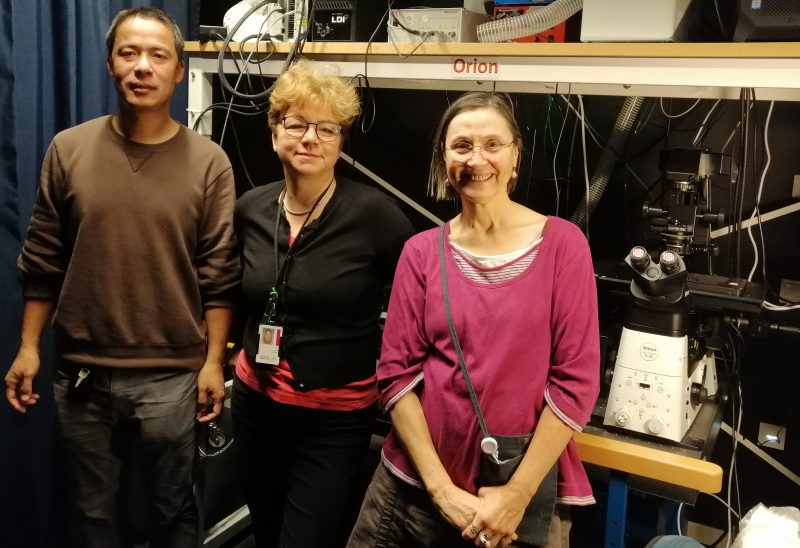
From left to right: Jianjiang Hu, Gabriela Imreh and Sylvie Le Guyader. Photo: Sylvie Le Guyader.
Building a career in research infrastructure
For many PhD students, the academic path most visible around them follows a familiar pattern: finish your PhD, move on to a postdoc, and possibly a principal investigator position. But what if there are other academic careers that are simply less visible?
At Karolinska Institutet, Sylvie Le Guyader leads the Live Cell Imaging Facility, supporting researchers with advanced microscopy and technical expertise. Her career has remained within academia, yet it has taken a different direction from the traditional PI route.
During her PhD in neurodevelopmental biology and later postdoc, Sylvie began to realize that the traditional academic research path was not the right long-term fit for her. Although she valued the scientific training, she found herself wanting to shape her career differently. She chose to build a career around her strengths and what she enjoyed most: microscopy. “I became very good at microscopy, and I realized I could take advantage of that,” she says.
Over time, she developed strong technical expertise in microscopy and began to recognize that this skill set could shape her professional future. During her postdoc, she took the initiative to purchase a confocal microscope, a decision that would later lay the groundwork for the Live Cell Imaging Facility at KI. What began with a confocal microscope gradually evolved into infrastructure leadership.
A Different Kind of Scientific Impact
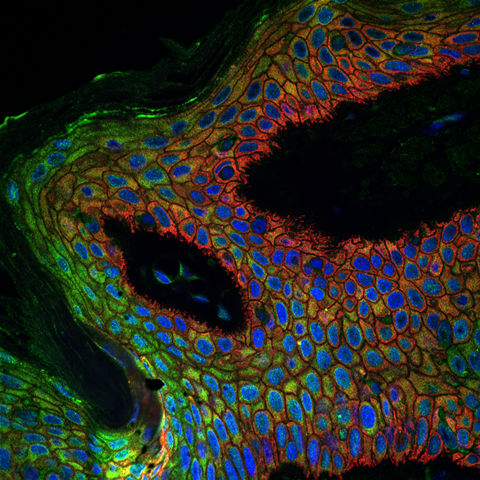
Today, Sylvie’s role extends far beyond microscopy itself. Much of her work now centers on teaching, developing microscopy courses, mentoring staff, applying for grants, managing budgets, evaluating new technologies, and planning the future development of the facility. She teaches both microscopy to students and training methods to core facility staff who support users in their daily work. Operating microscopes is no longer a central part of her work. “I do miss it a bit,” she says. These days, she mainly returns to the microscope when testing new systems or imaging students’ samples during courses. Together with her colleagues Gabriela Imreh and Jianjiang Hu, she leads the facility and emphasizes that the work is very much a team effort. She also serves on the committee board of KI’s core facilities, where she contributes to broader discussions on research infrastructure across the institute.
What brings her the greatest satisfaction at work is clear: “Helping people. I really enjoy the first meeting with new users, understanding their scientific question and figuring out how microscopy can help.”
That way of working also shapes how success is defined within a core facility. Success is not defined by publication numbers, but by providing strong scientific support, ensuring fair and sustainable access to equipment, ensuring clarity around access and costs, and serving researchers from different groups across the institute. Rather than driving a single project forward, Sylvie and her team contribute to dozens of research projects across KI.
Careers in research infrastructure are still not highly visible to early-career scientists. Yet Karolinska Institutet was among the first universities in Sweden to formally establish titles for “research infrastructure specialists”, acknowledging the essential role these positions play in supporting and advancing scientific research.
For PhD students who enjoy academia but are unsure which career paths to pursue, Sylvie’s journey highlights other ways to build a career within research. Beyond technical expertise, the role relies heavily on communication and collaboration. “You need strong communication skills,” she says. “You need to stay curious about research, be comfortable working in teams, and understand researchers’ questions well enough to guide them toward the right imaging approach.”
Reflecting on her career today, Sylvie smiles: “I feel very lucky. I enjoy going to work every day.”
Author’s note: Sylvie Le Guyader has generously shared her experience with several doctoral students in the KI doctoral course Career Skills for Scientists, where students explore academic career paths through informational interviews.
Read more about KI’s research infrastructure specialists in the KI News article New titles for the hidden specialists behind KI’s research, which also features Sylvie.

0 comments